In the Lotus Seven Owners Manual (my copy post August 1965) in Section ‘M’, page ‘M 2” under ‘2 – Maintenance Attention’, Lotus advises the following:
“With the introduction of the “Super 1500” models an improved water filler pipe has been fitted, this is called a Swirl Pot and acts as a centrifuge thus expelling any air that may be present in the water. The normal water level on the Swirl Pot is approximately 1/2 inch from the bottom.
It should be noted that, as the Ford 116E engine is 5/8 in. taller than the Ford 109E and 105E engines, different sized Swirl Pots are fitted in each application.”
However, a check of the part numbers for the Swirl Pots fitted to the Ford 109E and 116E engines shows the identical part number.
The Swirl Pot was continued with the Series 3 fitted to the 1600 c.c. Ford Crossflow 2737E engine, and also the 1300 c.c. model.
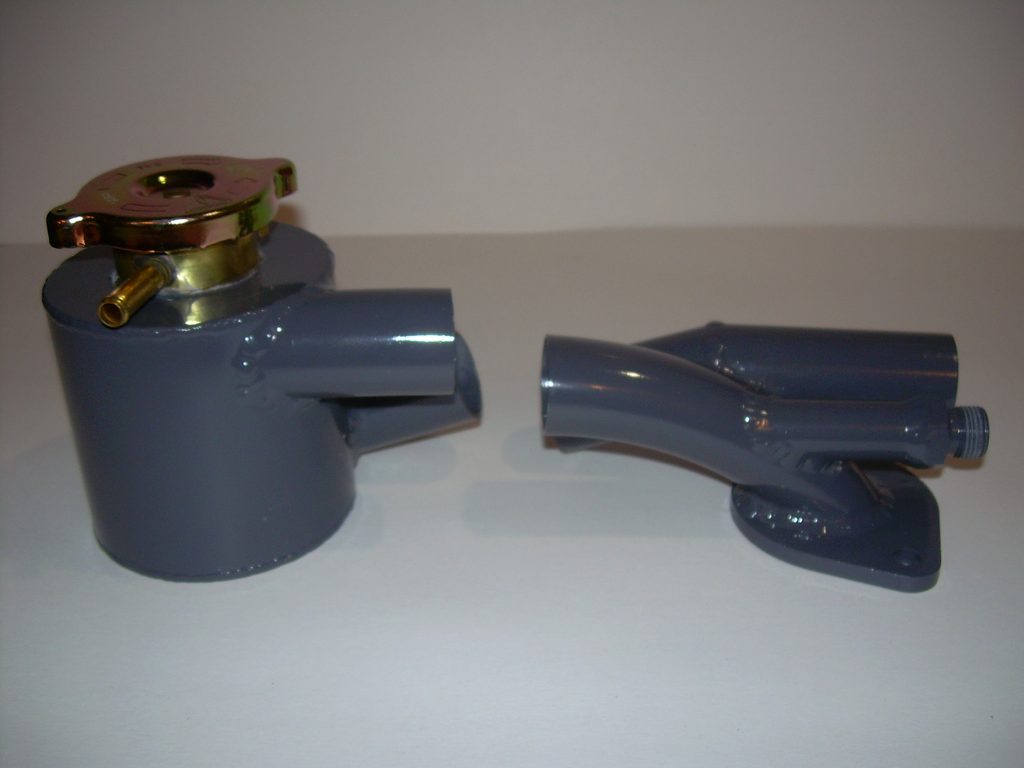
In a 1969 article featuring the then fairly new Lotus 7S, A.R.M. (Andrew Marriott) then writing for Motoring News magazine, conducted a road test of the car. Part way through the road test, the Swirl Pot cracked. Mr. Marriott drove the car to the premises of the Watford Mini ace, Mo Mendham, (who A.R.M. considered ‘true to his name’), who welded up the crack in the Swirl Pot. Unfortunately, the Swirl Pot cracked again during the same test, but not, as the author noted, at one of Mr. Mendham’s welds. A.R.M. then drove to Caterham Car Sales in Surrey, where Graham Nearn came to the rescue, and supplied one of their modified Swirl Pots that had been cut in two, and a rubber hose inserted in the main pipe so reducing the vibration that was causing the cracks to occur. (Note: Caterham Cars also reattached the dynamo that had taken to falling off during the road test).
On my Lotus Seven Series 3, the second owner had added a thick rubber gasket to the plate that bolts on to the cylinder head, and he did not tighten the bolts down too hard. He also installed a thermostat in the head, and he advised that during his ownership – using the car on the road, club race track, or parking lot slalom courses – the car had never overheated. I also experienced positive results with the set-up, and determined when it was necessary to activate the manually operated electric radiator fan.
Note: Lotus does not mention a thermostat in the owners manual, and Tony Weale in his ‘Lotus Seven’ book advises: “Lotus Series 2 and 3 cars fitted with both BMC and Ford pushrod engines are not normally fitted with thermostats.”
Another forum poster inquired regarding the connection of the sender capillary tube ‘bulb’ on the Smiths Instruments mechanical water temperature gauge.
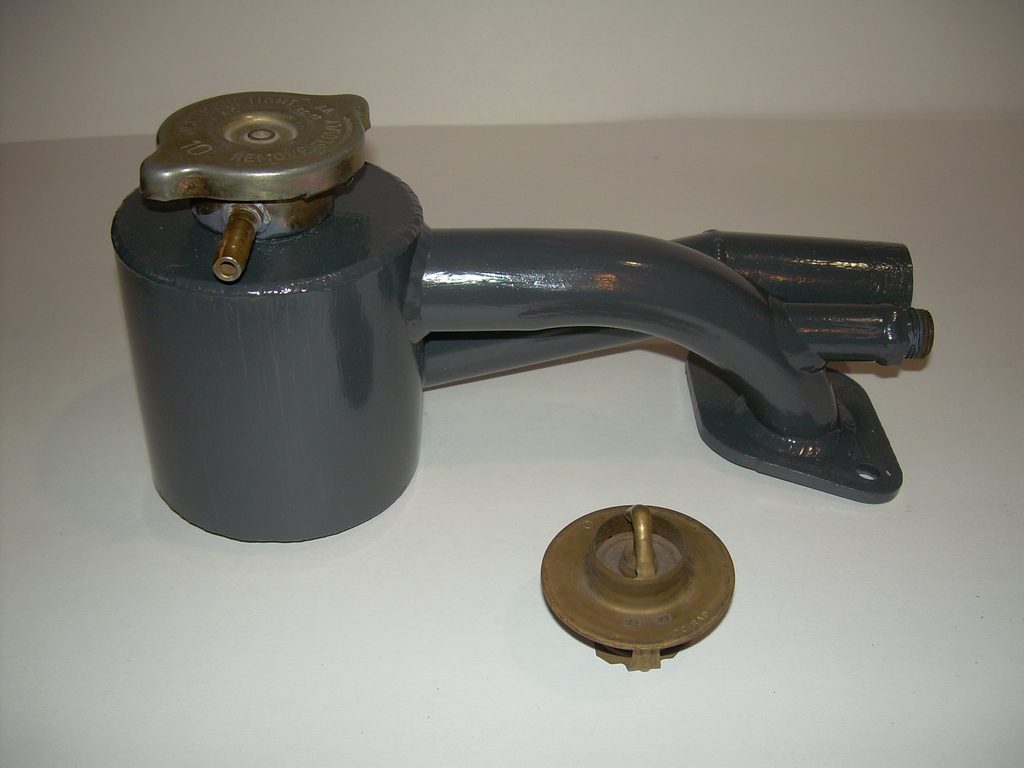
Lotus added a threaded boss on the end of the Swirl Pot to allow attachment of the capillary tube bulb if necessary. (Mick Beveridge of Xtra Special Sevens also incorporated this in to his excellent modified Swirl Pots as per the original Caterham Cars modified units).
On my original Ford pre-uprated 1600 Crossflow head, there was a tapping in the cylinder head fitted with a brass adapter. The capillary bulb screwed on to this adapter. I now have an uprated 711M cylinder head, but the tapping is now much smaller, designed to take an electric water temperature sender.
In the Brooklands Books soft cover booklet “Lotus Seven Gold Portfolio 1957 -1973” compiled by R.M. Clarke, there is a reprint of a two-part story from Cars and Car Conversions Magazine (July and August 1969), where a C&CC staff member assembled a Lotus Seven Series 3 kit, purchased from Caterham Cars (but picked up at Lotus in Hethel, to save delivery charges). In one of the black and white photos, the capillary bulb on this particular car is screwed directly into the Swirl Pot.
Following are photographs of an original Lotus supplied Swirl Pot from a 1969 Lotus Seven Series 3, and a photograph of the Swirl Pot constructed by Mick Beveridge of Xtra Special Sevens. Mick followed the practice of Caterham Cars by dividing the tubes in two.